Kesar Control Systems
Stability chamber
What is a Stability Chamber?
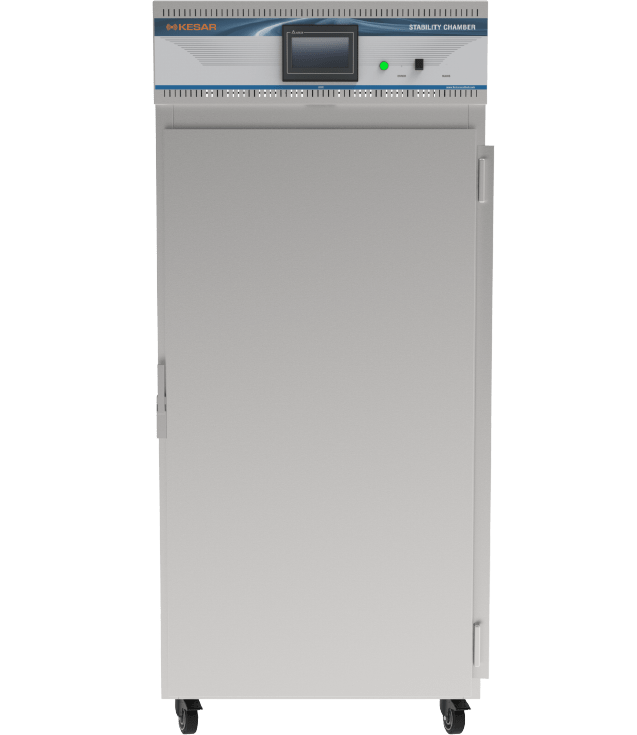
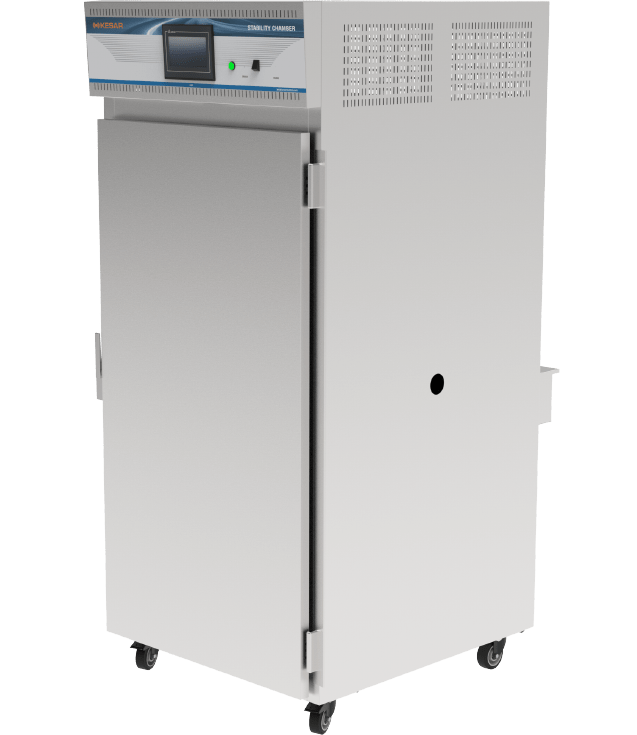
A Stability Chamber is a precision testing chamber that holds temperature and relative humidity at fixed, validated points for weeks, months, or years, so pharmaceutical, food, cosmetic, and biotech products can be studied for shelf life and stability. Every expiry date on a drug label depends on this kind of controlled, logged environment. Without it, there's no data to submit, and without submission, no regulatory clearance.
Kesar stability chambers hold two variables precisely, temperature and relative humidity, for 12 to 36 months without interruption, logging every reading so the resulting data satisfies CDSCO, USFDA, and WHO requirements. They're used across pharmaceuticals, food & beverage, cosmetics, biotechnology, agrochemicals, and medical devices.
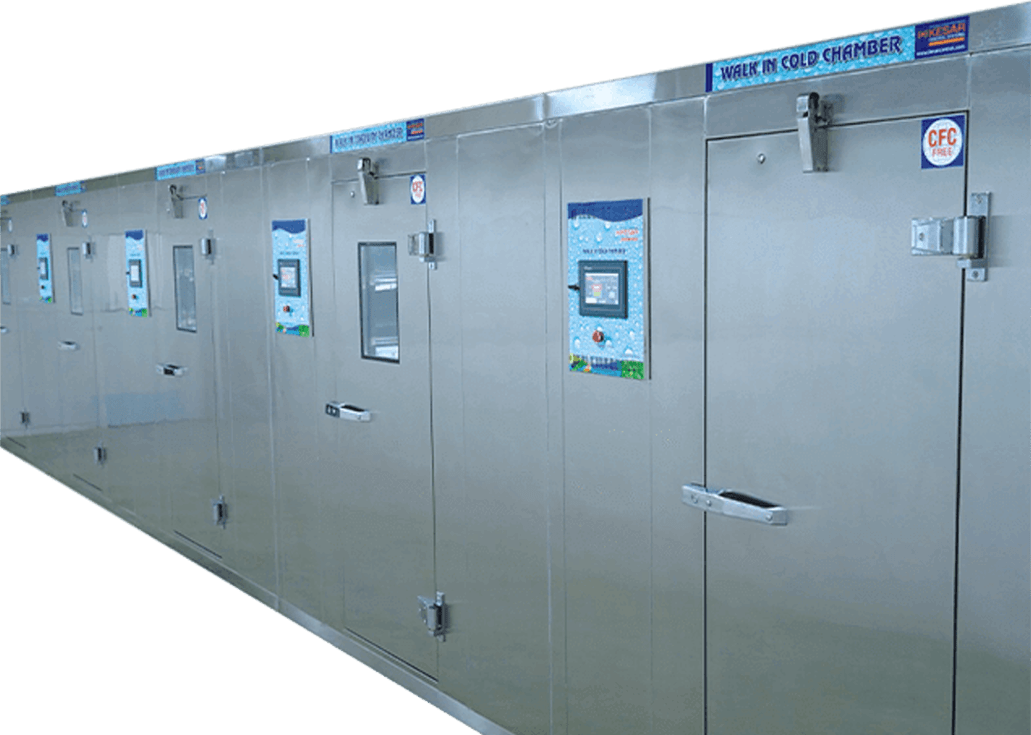
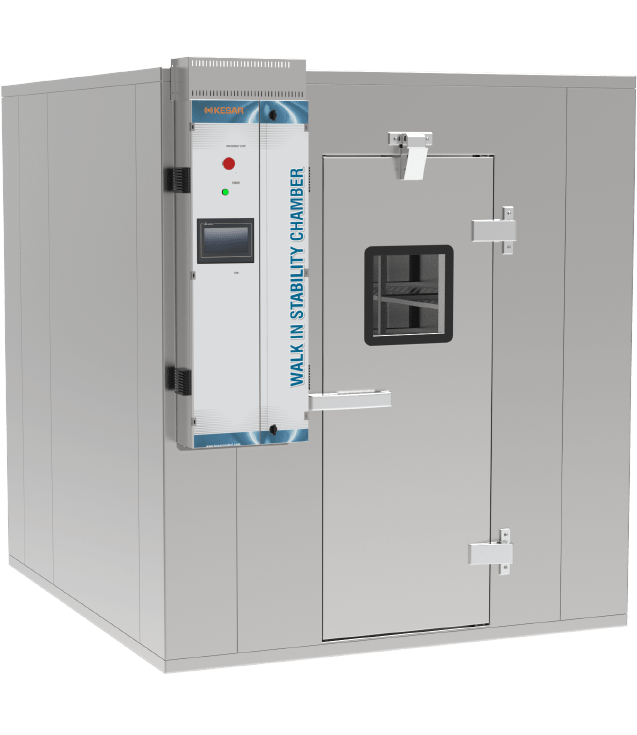
For manufacturers running concurrent studies at scale, our walk-in stability chamber delivers the same ICH-validated conditions in a room-sized format.
How a Stability Chamber Works
A stability chamber keeps temperature and humidity at a fixed set point for months or years. Sensors inside the chamber constantly measure both. The controller (PID or PLC) compares each reading with the set point and switches the heating, cooling and humidity systems on or off to correct any drift. Air is circulated so every shelf sees the same conditions. The software logs every reading and raises an alarm if a limit is crossed, such as a temperature deviation, a power failure or an open door. This is how the chamber holds ICH conditions like 25°C/60% RH or 30°C/75% RH for the whole study, so the data can support regulatory submissions.
Types of Stability Chambers
| Type | What it is | Best for |
|---|---|---|
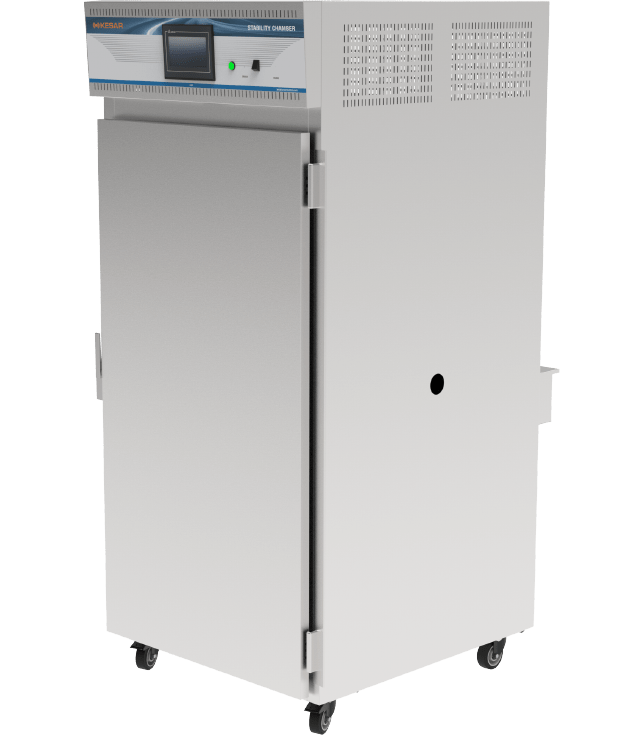
| Reach-in stability chamber (this page) | 90 to 1000 litre chambers with PID or PLC control | QC and R&D labs running a few studies at a time |
| Walk-in stability chamber | Room-sized chamber, also in an Eco Smart version | Large batches and many studies at once |
| Dual chamber | Two independent compartments in one unit | Running two conditions at once in less floor space |
| Photostability chamber | Tests the effect of UV and visible light (ICH Q1B) | Formulations, foods, cosmetics, packaging |
| Humidity chamber | Temperature and humidity chamber for shorter tests | Humidity-resistance, packaging and conditioning tests, not multi-year regulatory studies |
Construction
- Body fabricated on fully automatic CNC machines for dimensional precision and consistent quality across every unit.
- Interior made of high-grade stainless steel (SS 304 or SS 316, depending on model) with a dull finish, easy to clean, corrosion-resistant, and built for long-term cGMP use.
- Exteriors with model options of Stainless steel and G.I. Powder Coating.
- Exterior options: GI powder-coated (STD model), SS 304 dull finish (GMP and cGMP models); suitable for cleanroom and production environments.
- Illuminated interior with multi-pane insulated glass door, which prevents condensation so you can inspect samples without opening the chamber.
- Heavy-duty hinges and latches with full-perimeter silicone rubber gaskets on both inner and outer doors maintain a uniform airtight seal even after years of daily use.
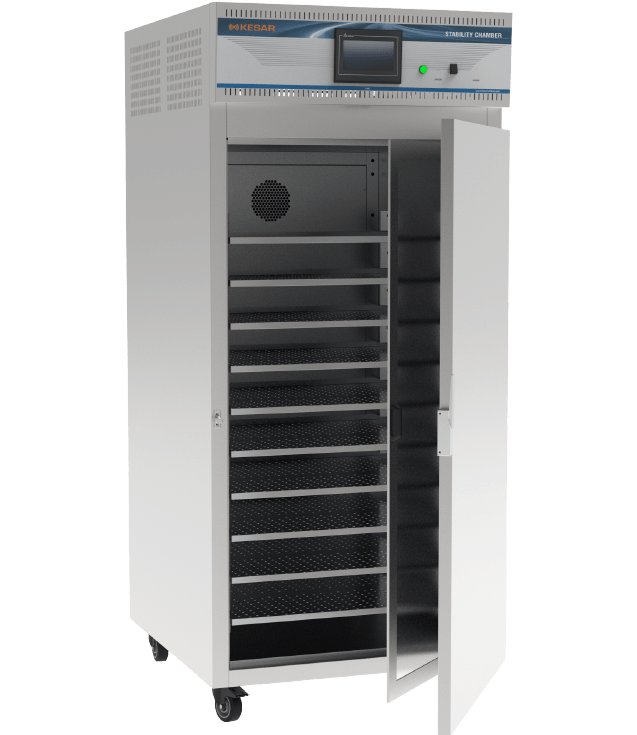
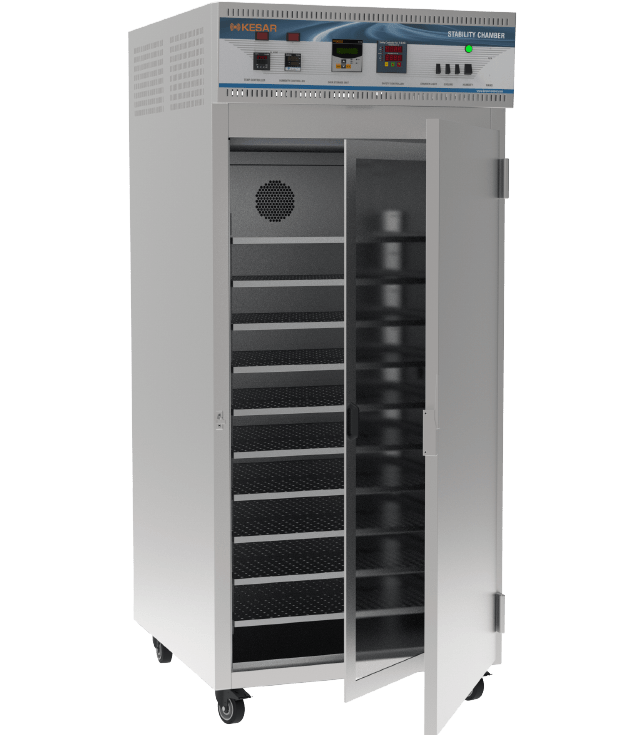
- Adjustable electro-polished wire mesh trays rated for up to 30 kg per tray (uniformly distributed), easy to clean, and repositionable for different sample sizes.
Quick Facts
| ICH conditions | 25°C/60% RH, 30°C/65% RH, 30°C/75% RH, 40°C/75% RH, plus low-humidity protocols |
|---|---|
| Range | 20–60°C, 40–95% RH |
| Capacity | 90 to 1,000 litres (8 models, KGOS-90 to KGOS-1000) |
| Control | PID or PLC with 7″ HMI |
| Materials | SS 304 or SS 316 interior |
| Compliance | 21 CFR Part 11 software, NABL-accredited calibration, IQ/OQ/PQ documentation |
| Support | AMC plans, service from two Vatva units |
Technical Specification
Kesar stability chambers are factory-configured to support all ICH Q1A(R2) test conditions, including long-term (25°C/60%RH), intermediate (30°C/65%RH), and accelerated (40°C/75%RH), with accuracy well within regulatory tolerance limits. For light exposure studies under ICH Q1B, samples are tested in a photostability chamber.
| Temperature Range | 20 ℃ to 60 ℃ |
|---|---|
| Humidity Range | 40%RH to 95%RH |
| Accuracy | ±0.2 ℃ & ±2.0% RH |
| Uniformity | ±2.0 ℃ & ±3.0% RH |
| Test Suitable For | 25 ℃ & 60% RH, 30 ℃ & 65% RH 40 ℃ & 75% RH, 30 ℃ & 75% RH |
| Specially designed chambers for Low Humidity conditions such as 25 ℃ 40% RH, 40 ℃ 25% RH, 30 ℃ 35% RH | |
| Control System | PLC or PID Based |
Material of Construction
| Models | Material Of Construction | |
|---|---|---|
| Interior | Exterior | |
| STD | S.S.304 Dull Finish | G.I Powder Coated |
| GMP | S.S.304 Dull Finish | S.S.304 Dull Finish |
| CGMP | S.S.316 Dull Finish | S.S.304 Dull Finish |
Sizes
| Models | Capacity (in ltrs.) | Dimensions (W X D X H) | Max No. of Trays | |
|---|---|---|---|---|
| Internal Width X Depth X Height (mm) |
External Width X Depth X Height (mm) |
|||
| KGOS-90 | 90 LTR | 450 X 450 X 450 | 600 X 1030 X 1060 | 2 |
| KGOS-227 | 227 LTR | 600 X 630 X 600 | 750 X 1210 X 1210 | 2 |
| KGOS-325 | 325 LTR | 600 X 630 X 900 | 750 X 1210 X 1510 | 5 |
| KGOS-400 | 400 LTR | 600 X 630 X 1060 | 750 X 1210 X 1670 | 6 |
| KGOS-500 | 500 LTR | 600 X 630 X 1330 | 750 X 1210 X 1940 | 8 |
| KGOS-600 | 600 LTR | 800 X 800 X 950 | 950 X 1380 X 1560 | 5 |
| KGOS-800 | 800 LTR | 800 X 800 X 1250 | 950 X 1380 X 1860 | 7 |
| KGOS-1000 | 1000 LTR | 800 X 800 X 1570 | 950 X 1380 X 2180 | 10 |
How to Choose a Stability Chamber
Choose by batch size, control level and audit needs:
Capacity: 90 to 227 litres for R&D and small batches; 325 to 500 litres for QC labs running several products; 600 to 1000 litres or a walk-in chamber for concurrent long-term, intermediate and accelerated studies.
Control: PID for single-chamber labs with standard monitoring; PLC with a 7-inch HMI for multi-chamber sites that need remote monitoring and stricter audit trails.
Build: STD (SS 304 inside, GI powder-coated outside), GMP (SS 304 inside and outside) or cGMP (SS 316 inside, SS 304 outside), depending on your facility.
Not sure which fits? Talk to our team and we will recommend a model.
Stability Chamber Price in India: What Affects the Cost
The price of a stability chamber depends on how it is configured, not only its size. The main factors are:
Capacity: 90 to 1000 litres, or a walk-in chamber for large batches.
Control system: PID-based or PLC with HMI.
Build: STD, GMP or cGMP model (SS 304 or SS 316).
Optional systems: standby humidity and refrigeration, multi-channel scanner, GSM alerts, security alarm.
Software and documents: 21 CFR Part 11 software, IQ/OQ/PQ package, NABL calibration.
Service: annual maintenance contract (AMC).
Share your batch size, test conditions (for example 30°C/75% RH) and control preference, and our team will send a quotation.
How It Maintains Accuracy
What Makes Stability Testing Accurate
Regulatory guidelines are precise about what's acceptable: temperature must not deviate beyond ±2°C from the setpoint, and humidity must stay within ±5% RH throughout the study period. Kesar chambers achieve ±0.2°C temperature accuracy and ±2% RH humidity accuracy well inside these limits.
This is possible because of how temperature and humidity interact. Warm air holds more moisture than cool air. As the temperature rises, the relative humidity drops. A well-designed stability chamber controls both simultaneously, not independently, using PID or PLC logic that makes continuous micro-adjustments based on sensor feedback, not periodic corrections.
ICH Q1A(R2) defines three standard test conditions every pharmaceutical product must pass before regulatory approval:
- Long-Term: 25°C ± 2°C / 60% ± 5% RH: Minimum 12-month study, required for all drug registrations
- Intermediate: 30°C ± 2°C / 65% ± 5% RH: Triggered when a significant change appears during the accelerated study; also, the primary condition for Zone IVb countries, including India
- Accelerated: 40°C ± 2°C / 75% ± 5% RH: 6-month study designed to fast-track shelf-life prediction
Kesar Chambers also supports specialized low-humidity conditions: 25°C/40%RH, 40°C/25%RH, and 30°C/35% RH—for hygroscopic formulations and specific stability protocols.
Full View Glass Door
The door is where most chambers lose temperature and humidity during a study, either through poor insulation, gasket degradation, or condensation that signals heat loss. Kesar Chambers uses a multi-pane insulated glass door that keeps the inner glass surface warm enough to prevent condensation at all times. The full perimeter of both inner and outer doors is sealed with silicone rubber gaskets. QC managers can visually inspect every shelf without opening the door, without disturbing conditions, and without generating a door-open event in the data log.
Get Solution
Contact Kesar Control today to learn more about their Products and get a quote.
Contact NowDownload Catalogue
Features
- Heavy-duty stainless steel construction, SS 304 or SS 316 depending on model, built to withstand continuous 24/7 operation for the full duration of multi-year stability studies.
- LED-illuminated interior for clear visibility of all shelf positions without opening the door.
- Multi-pane condensation-free viewing door. Inspect product condition at any time without affecting the test environment.
- Electro-polished wire mesh trays. Hygienic, easy to clean, and adjustable to accommodate different product sizes and loading configurations.
These are the standard features; see the full set of equipment features available across our laboratory equipment range.
Optional Features
- Standby humidity system: automatic switchover if the primary humidity system trips; study continues without interruption or manual intervention.
- Standby refrigeration system: redundant cooling ensures the chamber holds temperature even if the primary compressor requires maintenance.
- Multi-channel scanner: simultaneous monitoring across multiple chambers from a single interface.
- GSM alert system: sends SMS notifications to up to 6 registered numbers the moment any alarm condition is triggered, such as temperature deviation, power failure, door open, or low water level.
- Security alarm system: unauthorized access protection with password-controlled door entry and audit trail.
- Microprocessor based PID controller with auto tuning for accurate control of temperature and humidity conditions.
- Rotronic make 4-20mA sensors for better accuracy/ Pt100 Sensor for Temperature & Direct % RH electronic capacitor type humidity.
- Data Storage unit facility to store data and to print directly on printer or transfer to software with Date, Time, SV, PV, Door Open/ Close, Power On/Off remarks.
- Safety: Temperature & Humidity High / Low Alarm, Temperature very High / Low cut off, Water level low cut off.
- 7″ HMI with TFT LCD Colour touch screen with password protection for all parameter actual status monitoring of utilities like Sensor, Heating & Cooling System, and Humidity System.
- Rotronic make 4-20mA sensors for better accuracy.
- PLC with auto tuning facility for accurate control of temperature and humidity conditions.
- PLC system for an auto changeover of standby systems.
- Data Storage unit facility to transfer the data to software via Ethernet for web based online remote monitoring with Date, Time, SV, PV, Door Open/ Close, Power On/Off remarks. Also transfer the data through USB.
- Safety/Alert: Temperature & Humidity High / Low alarm, Temperature & Humidity High / Low cut off, Low water level cut off, Auto change over for standby systems
Safety Features
- Multi-level password-protected door access, which restricts unauthorized operation and logs every access attempt with user ID and timestamp.
- Temperature and RH deviation alarms, which triggered immediately if actual values drifted beyond configured tolerance limits.
- Power failure alarm with date and time stamp, complete record of any power interruption during the study period.
- Continuous open-door alarm, audible and data-logged alert if the door remains open beyond a set duration.
- Extreme temperature and RH cut-off, hard protection that shuts down heating or humidification if values exceed safe operating limits, protecting both product and equipment.
- Low water level cut-off prevents the humidity generator from running dry, which can cause component damage and humidity control failure.
- Automatic changeover for standby RH generator and cooling system, zero manual intervention required during a fault condition.
- Heavy-duty door hinges and latches with full-perimeter silicone rubber gaskets on inner and outer doors, a uniform seal maintained across the full lifespan of the equipment.
Software (21 CFR Part-11 Compliance)
For pharmaceutical companies submitting stability data to the USFDA, EMA, or CDSCO, 21 CFR Part 11 compliance is not optional; it's a prerequisite for regulatory acceptance. Kesar's 21 CFR Part 11 software is built to meet these requirements out of the box:
- Multi-level alphanumeric password protection with configurable password ageing
- Secured audit trail, where every parameter change logged with user ID, old value, new value, and timestamp
- Electronic records (e-Records) and electronic signatures (e-Signatures) as required by 21 CFR Part 11
- Complete event log: door open/close, power on/off, alarm triggers, and system changeovers
- Graphical and tabular data analysis with export to standard formats
- Mean Kinetic Temperature (MKT) calculation for any selected date range
- Multi-chamber monitoring on a single software dashboard
- LAN/Ethernet connectivity for server-based storage and web-based remote monitoring
- GSM mobile alerts to up to 6 registered numbers for any alarm condition
- USB data transfer and direct printer output
Trays
All chambers are supplied with heavy-duty electro-polished wire mesh trays. The wire mesh design allows for maximum airflow around samples, critical for uniform temperature and humidity distribution at every shelf level. Trays are adjustable in height, rated for up to 30 kg uniformly distributed load, and designed to be removed and cleaned quickly without tools.
Uses of Stability Chambers by Industries We Supply
Kesar stability chambers are in use across regulated and quality-driven industries, wherever shelf life, product degradation, or regulatory approval depends on documented environmental testing:
Pharmaceuticals: ICH Q1A long-term, intermediate, and accelerated studies for APIs, finished dosage forms, and primary packaging materials. Required for CDSCO new drug applications and USFDA ANDA/NDA submissions.
Biotechnology: Stability studies for biologics, biosimilars, vaccines, and recombinant proteins under ICH Q1A and Q5C guidelines.
Food & Beverage: Accurate best-before date determination under simulated real-world storage conditions for FSSAI and export compliance.
Cosmetics: Physical and chemical stability validation supporting shelf-life claims and Bureau of Indian Standards compliance.
Agrochemicals: Pesticide and fertilizer formulation stability under tropical climate conditions as per CIB&RC registration requirements.
Medical Devices: Packaging material compatibility and device stability data for CDSCO MD-15 submissions.
Why Pharma Companies Across India Choose Kesar
NABL-Accredited Calibration: Calibration certificates from an NABL-accredited lab, not outsourced to a third party. Traceable, regulator-accepted, and issued by your chamber. No separate calibration vendor, no coordination delay before your study starts.
IQ/OQ/PQ Validation Documentation: Full Installation Qualification, Operational Qualification, and Performance Qualification documentation is available as a packaged option. The complete validation bundle your regulatory affairs team needs for CDSCO, USFDA, or EU-GMP facility audits.
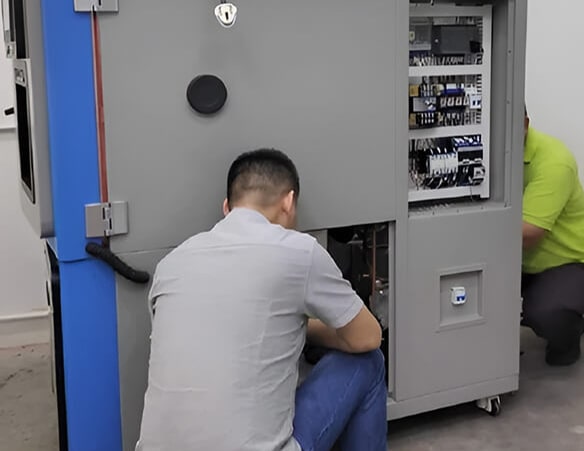
AMC — Annual Maintenance Contracts: Stability studies run for years. So do our service commitments. AMC plans cover scheduled preventive maintenance, annual NABL calibration, and emergency response, so a compressor issue at month 10 of a 12-month study doesn't become a crisis.
Manufactured in India: Two manufacturing units in GIDC Vatva, Ahmedabad. Faster delivery across India, local service engineers, and immediate spare parts availability without the lead times and import complications of foreign equipment.
Kesar provides 70% energy saving and 90% water savings technology in the stability chamber.
FAQ'S
A stability chamber is environmental testing equipment that holds temperature and relative humidity at defined setpoints for weeks, months, or years while products are stored inside. Every expiry date on a drug label is backed by a stability study. Regulatory bodies like CDSCO, USFDA, and WHO require this documented shelf-life data before a product can be approved for sale, which makes a stability chamber mandatory equipment for any pharmaceutical manufacturer seeking regulatory clearance.
A stability chamber is designed for long-duration shelf-life studies with tight tolerances (±2°C / ±5% RH under ICH limits), primarily for pharmaceutical and food applications under ICH or similar guidelines. An environmental chamber simulates a broader range of harsh conditions like thermal shock, vibration, altitude and extreme humidity, and is more commonly used for electronics, automotive and industrial product stress testing.
Kesar chambers support all ICH Q1A(R2) conditions: Long-term (25°C/60%RH), Intermediate (30°C/65%RH and 30°C/75%RH for Zone IVb), and Accelerated (40°C/75%RH). They also support low-humidity protocols: 25°C/40%RH, 40°C/25%RH, and 30°C/35%RH.
For R&D labs testing small batches, 90–227 litre chambers (KGOS-90 or KGOS-227) are typically sufficient. Mid-sized QC departments testing multiple products simultaneously usually need 325–500 litres. Large pharmaceutical manufacturers running concurrent long-term, intermediate, and accelerated studies should consider 800–1,000 litre chambers or a walk-in stability chamber.
A PID-based chamber uses a microprocessor controller with auto-tuning and is a cost-effective choice for single-chamber labs with standard monitoring needs. A PLC-based chamber adds a 7" HMI touchscreen, automatic changeover for standby systems, and web-based remote monitoring — better suited to multi-chamber facilities that need centralized data acquisition and stricter 21 CFR Part 11 audit trails.
Yes. Kesar provides Installation Qualification (IQ), Operational Qualification (OQ), and Performance Qualification (PQ) documentation as an optional package — the full validation package required for regulated pharmaceutical facilities undergoing CDSCO, USFDA, or EU-GMP audits.
At least once a year, with mapping studies at installation and after any major maintenance or relocation. Kesar's AMC (Annual Maintenance Contract) plans include scheduled preventive maintenance and NABL-accredited calibration with traceable calibration certificates.
The price depends on capacity (90 to 1000 litres), PID or PLC control, the build (STD, GMP or cGMP), optional standby systems, and the validation and calibration package. Share your requirement through the quote form or call +91-6354883229 and we will send a quotation.
Under ICH Q1A(R2), long-term studies run for at least 12 months at the time of submission and continue through the proposed shelf life, often 24 to 36 months. Accelerated studies run for 6 months.
Zone IVb covers hot and very humid regions, including India. WHO guidance sets the long-term storage condition for Zone IVb at 30°C / 75% RH, with accelerated testing at 40°C / 75% RH.
A reach-in chamber (90 to 1000 litres) suits QC and R&D labs running a few studies at a time. A walk-in chamber is a room-sized unit that larger manufacturers use to store many batches under the same ICH condition at once.